
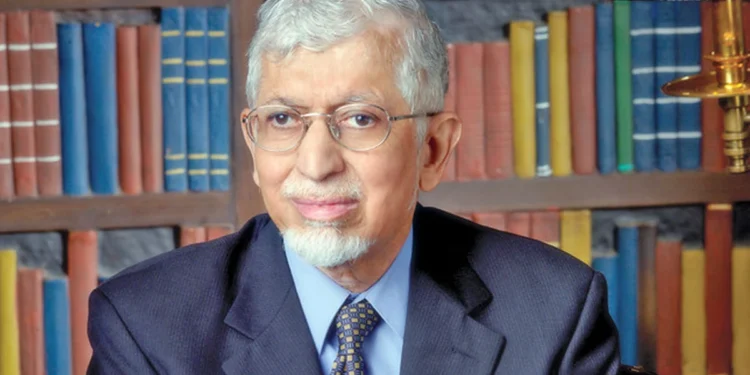
Muhammad Umer Chapra was one of the founding figures of modern Islamic economics. Across five decades of writing and policy work, he argued that economies should be judged by whether they meet human needs, reduce injustice and keep finance tied to the real economy. The Islamic Development Bank Institute, which described him as a pioneering figure in the field, announced that he passed away on 13 June 2026.
An economist with a central banker’s view
Chapra earned bachelor’s and master’s degrees from Karachi University in 1956 and a PhD from the University of Minnesota in 1961. He worked in Pakistan and the United States before spending 34 years as an adviser to the Saudi Arabian Monetary Agency.
That background shaped his work. He wrote as someone who had dealt with inflation, fiscal deficits and monetary policy at first hand, not as a theorist working only from texts. His arguments about morality in economics always came back to practical questions: how to reduce poverty, how to keep finance stable and how to design institutions that people can trust.
His contribution was widely recognised. He was the first winner of the Islamic Development Bank’s prize for services to Islamic economics in 1989, and he received the King Faisal International Prize for Islamic Studies in 1990. The King Faisal Prize cited his work on financial dealings in Islamic law and his thinking about a more just monetary system.
Economics is never value-free
The starting point of Chapra’s thought is that every economic system rests on assumptions about human nature, ownership and what counts as success. Mainstream economics often models people as self-interested utility maximisers and relies on prices to coordinate their choices. Chapra did not deny that self-interest exists or that prices carry useful information. His concern was that self-interest without moral limits can push markets toward exploitation, excessive consumption, speculation and inequality.
He argued that an economy needs a moral filter. Before asking whether something is profitable, people should also ask whether it is just, whether it harms others and whether it uses resources responsibly. In Islamic terms, that filter comes from accountability before God, lawful earning, concern for the poor and the maqasid al-shariah, the higher objectives of Islamic law that centre on human welfare.
This did not make him anti-market. Markets, in his view, are good at encouraging effort, innovation and exchange. They are not good at producing restraint or fairness on their own, which is why they need ethical norms and sound institutions around them.
Beyond capitalism and socialism
Chapra criticised both dominant modern systems. Capitalism, he argued, generated wealth but lacked strong restraints on greed, inequality and speculation. Socialism promised equality but concentrated power, weakened individual initiative and allocated resources poorly. The welfare state tried to correct capitalism’s failures but, in his reading, ran into fiscal limits without changing the underlying incentives.
His alternative combined market mechanisms with moral motivation, zakat and other forms of redistribution, the prohibition of riba and a state with a clear but limited role. The state should regulate, provide public goods and protect the vulnerable, but it should not replace private initiative or the moral responsibilities of families and communities.
Islam and the Economic Challenge
His best-known book, Islam and the Economic Challenge, published by the International Institute of Islamic Thought in 1992, brings these ideas together. It asks whether Muslim countries can design a strategy that reduces macroeconomic and external imbalances while achieving full employment, removing poverty, meeting basic needs and narrowing income and wealth inequality.
The book reviews the shortcomings of capitalism, socialism and the welfare state, then sets out an Islamic framework built on need fulfilment, justice and restructuring of incentives and institutions. It is demanding reading for beginners, but it remains the most complete statement of his worldview.
Core principles of his framework
- Justice as a goal of the system: fairness should be built into the rules of economic life, not added afterward as charity.
- Need fulfilment first: meeting basic needs should not be postponed in the name of growth.
- Well-being beyond income: development includes dignity, education, family stability and social cohesion as well as output.
- Finance serving the real economy: money and credit should support trade, production and investment rather than debt expansion and speculation.
- A balanced state: active in regulation and public goods, accountable and limited in its reach.
Islamic finance as a means, not the whole project
Many readers know Chapra through Islamic finance, and his work on interest, risk sharing and monetary systems was influential. But he saw Islamic finance as a tool within a larger economic vision. In his view, Islamic banking should not simply replace conventional products with Arabic names. It should link finance to real assets and productive investment, share risk fairly and avoid shifting losses onto weaker parties.
That standard cuts both ways. It challenges conventional finance to face the consequences of debt-driven instability, and it challenges Islamic banks to live up to their own ethical claims rather than settling for compliance in form only. This is one reason regulators and product teams still read his work alongside academics.
Development and social justice
For Chapra, development meant more than a higher growth rate. A country could grow in aggregate while failing most of its people if gains were captured by a narrow group. He argued that poverty reduction needs productive capacity, jobs, education, infrastructure and fair access to finance, and that without moral commitment and accountable institutions, policy is easily captured by elites or weakened by corruption.
His idea of justice combined distribution with participation. People need protection from exploitation, but they also need real paths to work, ownership and enterprise. Zakat, charitable giving, inheritance rules and the ban on exploitative finance all play a part in keeping wealth circulating.
Why his work still matters
Many of the questions Chapra raised are now part of mainstream debate: financial instability, rising inequality, household debt and whether businesses should serve stakeholders beyond shareholders. His work pushes movements such as ESG and impact investing to look past branding and ask whether risks are shared fairly and whether financial products meet real needs.
It also sets a test for Muslim societies and Islamic institutions. Claiming an Islamic identity while tolerating corruption, waste or superficial compliance falls short of the standard he described. His framework is not a ready-made blueprint, and applying it requires judgment about local law, capacity and context. What it offers is a clear set of questions for anyone who wants an economy that is both productive and fair.
Related reading: profiles of fellow Islamic economists Mohammad Nejatullah Siddiqi and Monzer Kahf, and of Saudi economist and Shariah board scholar Mohamed Ali Elgari.
FAQ
An economist, educated at Karachi University and the University of Minnesota, who spent 34 years as an adviser to the Saudi Arabian Monetary Agency and became one of the founders of modern Islamic economics. He died on 13 June 2026.
Islam and the Economic Challenge, published in 1992.
The first IsDB prize for services to Islamic economics (1989) and the King Faisal International Prize for Islamic Studies (1990).