
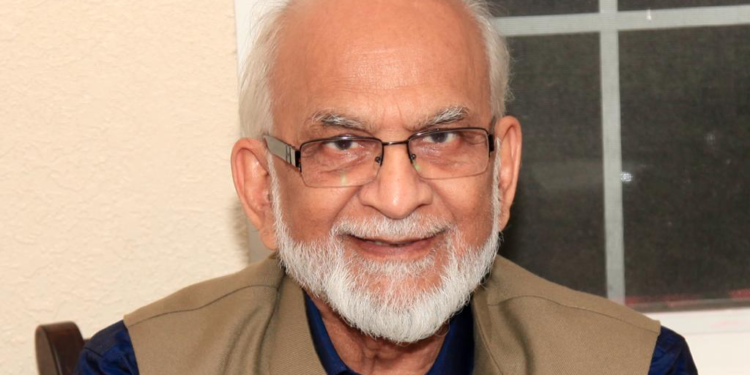
Mohammad Nejatullah Siddiqi (1931 to 2022) was an Indian economist and one of the founders of modern Islamic economics. His book Banking Without Interest set out how banks could work on profit-and-loss sharing instead of interest, and in 1982 he received the King Faisal Prize for Islamic Studies for his work on contemporary economic problems.
Quick facts: who was Nejatullah Siddiqi?
| Born | 1931, Gorakhpur, British India |
| Died | November 2022, California, aged 91 |
| Education | Aligarh Muslim University |
| Academic posts | Aligarh Muslim University; King Abdulaziz University, Jeddah; UCLA (fellow); Islamic Research and Training Institute, IsDB (visiting scholar) |
| Award | King Faisal Prize for Islamic Studies (1982) |
| Key books | Banking Without Interest (1983); Partnership and Profit-Sharing in Islamic Law (1985) |
What was his career?
Siddiqi studied at Aligarh Muslim University in India and taught there for many years as an associate professor of economics and professor of Islamic studies, later becoming professor emeritus, according to his Wikipedia biography. He then moved to King Abdulaziz University in Jeddah as professor of economics at its Center for Research in Islamic Economics, and later held positions at UCLA and the Islamic Development Bank’s research institute. He supervised doctoral theses in India, Saudi Arabia and Nigeria.
What did he argue in Banking Without Interest?
Banking Without Interest argued that banks could raise and invest money through profit-sharing partnerships rather than loans at fixed interest. In his model:
- depositors place money with the bank and receive a share of actual profits rather than a guaranteed rate;
- the bank invests in businesses through partnerships such as mudarabah and musharakah;
- entrepreneurs share profits with the bank in an agreed ratio;
- losses are borne by capital providers, which pushes banks to assess projects carefully.
The book also dealt with practical banking questions, including bills of exchange and interest-free loans. Its central point was that riba, the prohibition on interest that the IMF notes is the starting point of Islamic banking, is about who bears risk. A fixed-interest lender takes a guaranteed return while the borrower carries all the business risk; a partner shares both.
What else did he write about?
His interests went well beyond banking. His books include Islam’s View on Property (1969), Economic Enterprise in Islam (1972), Muslim Economic Thinking (1981), Insurance in an Islamic Economy (1985) and Role of State in Islamic Economy (1996). The King Faisal Prize biography highlights his work on ownership and the state’s role in the economy, where he argued that markets need ethical limits and that the state has a duty to meet basic needs and prevent exploitation.
Why does his work still matter?
Siddiqi’s ideas provide a yardstick for today’s industry. Most Islamic bank financing now uses sale and lease contracts such as murabaha and ijarah, which give the bank a fixed return, rather than the partnership model he championed. His work is often cited in debates over whether Islamic finance has matched its own ideals or only avoided interest in form. Readers interested in that debate can also look at the work of Umer Chapra, a contemporary who also worked in Saudi Arabia.
FAQ
In November 2022 in California, aged 91.
Banking Without Interest, published in English in 1983.
Yes, the King Faisal Prize for Islamic Studies in 1982.